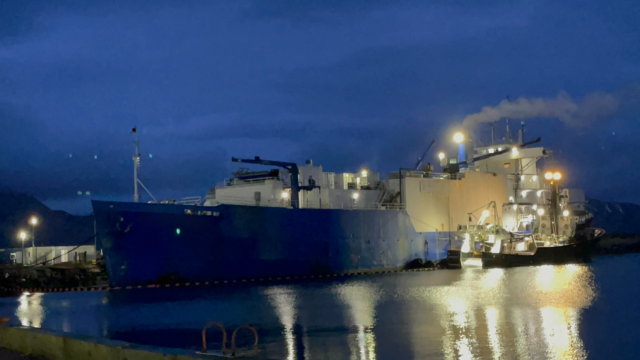
On a remote island in Alaska, where flights are unreliable, weather determines schedules, and fishing factories operate around the clock, hearing conservation looks very different from the rest of the country.
For Deborah Osmun, founder of Aleutian Audiometrics, that’s exactly why she established her business there. “It was time for a career change, and I didn’t want to leave my area because I love it here,” Deborah explains. “I liked that I’d be filling a need in my community.”
That community includes large-scale seafood processing facilities operating under some of the most challenging conditions imaginable. High noise levels, constant movement, and a workforce that arrives in waves from all around the world.
And before Deborah, there wasn’t a reliable local solution for hearing testing.
The Reality of Remote Hearing Conservation
Getting to the Aleutian Islands isn’t easy.
“We are in a unique location where the only way onto the island is by plane or by boat,” Deborah says. “Flights depend largely on the weather… There are times when it is not safe for flights to come in for extended periods of time.”
Sometimes, hundreds of workers are delayed for weeks just trying to get there.
But once they do, operations keep going.
“These are plants that process seafood 24 hours a day. They can’t just shut everything down for hearing testing to occur,” she explains. “Noise is going to happen… people have jobs to do.”
Forklifts move. Containers are loaded. Boats sound their horns. Power is generated on-site. There’s no such thing as a perfectly controlled environment.
And historically, there hasn’t been a sound booth either.
Rethinking the Model from the Ground Up
In many areas, hearing conservation programs are centered on fixed infrastructure. A clinic. A booth. A controlled space.
That model isn’t applicable to the Aleutians.
“Due to our remote location and the difficulty of getting things out here, to my knowledge, sound booths have not been brought here for testing,” Deborah says.
Instead of trying to force that model to work, Deborah built her approach around WAHTS from the beginning.
I chose WAHTS because of the portability of their units, the built-in sound booth technology, and the ability to run an SLM (Sound Level Meter) constantly that automatically pauses testing to stay in compliance.
The result is a fundamentally different approach to testing, one that adapts to the environment rather than trying to control it.
Testing That Moves with the Work
One of the main challenges in industrial settings is balancing compliance with production.
In seafood processing facilities that operate 24/7, shutting down for testing simply isn’t an option.
WAHTS Hearing changes that dynamic.
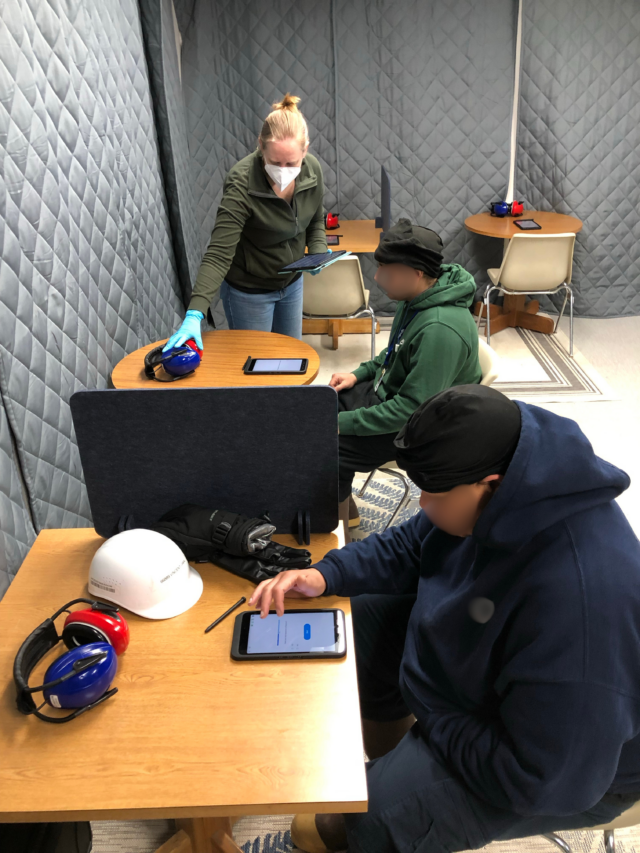
“The built-in sound booth technology paired with the continuous use of the SLM during testing really helps in the environments that I test in,” Deborah explains. “It makes it possible to be flexible with where the testing occurs and also limits the interruptions to production while still increasing accuracy.”
Testing can be done on-site during operations without pulling workers away for long periods or waiting for perfect conditions that don’t exist.
Speed, Scale, and Flow
Deborah’s work rhythm is driven by the fishing seasons. Workers arrive in large groups, often unexpectedly, and must be tested quickly.
WAHTS allows her to meet that demand.
“I’ve done as few as 10 to more than 140 tests,” she says.
But equally important as volume is how the process flows.
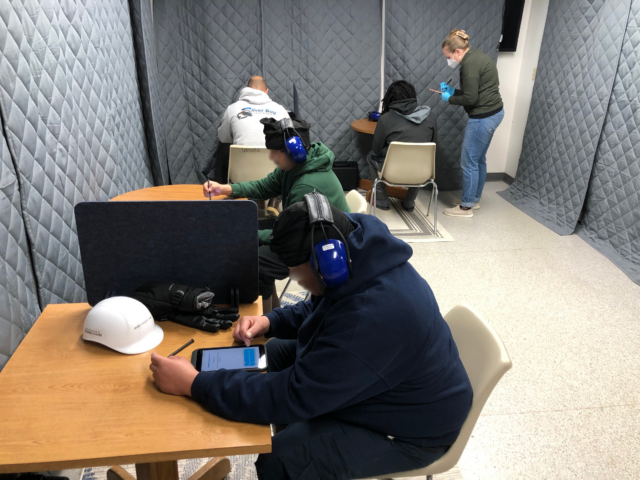
“There’s no more waiting for everyone in a group to finish all at once, thanks to asynchronous testing.”
That shift reduces bottlenecks, increases the number of employees scheduled per hour, and keeps operations running smoothly.
A Better Experience for a Global Workforce
The Aleutian workforce is very diverse, with workers from around the world. Many of them do not speak English as their first language.
That can cause friction in traditional testing environments.
“There are many people who do not speak English,” Deborah says. “Being able to have instructions, questions, and test people in their native language really improves the workflow and accuracy of results.”
The impact is direct and human.
“When the language that an employee is comfortable with is available, there is a visible relaxation in their body.”
That type of comfort directly leads to improved engagement and more dependable results.
Built for Compliance in Complex Conditions
Managing hearing conservation across multiple job sites, rotating crews, and shifting schedules requires more than just testing equipment. It demands a well-organized system.
WAHTS, combined with OccuSound®, provides that structure.
“The integration with OccuSound has streamlined onsite testing with the data management,” Deborah says. “It makes it easier for me to complete large testing groups on consecutive days in different locations.”
With quicker data processing and expert review, Deborah can stay compliant without increasing administrative workload, even in a fast-paced environment.
Ready When the Work Arrives
In the Aleutians, timing is seldom predictable.
Flights are delayed. Crews arrive late. Schedules shift with the weather. Deborah has adjusted by making her availability just as flexible.
“I am available to work 24 hours a day, 7 days a week to make sure that the needs of my customers are met.”
WAHTS supports that responsiveness, enabling testing to occur immediately when workers arrive, not after days or weeks.
A Foundation, Not Just a Tool
For Deborah Osmun, WAHTS isn’t just an improvement over traditional methods. It’s what enables her entire model to work.
“Everything about WAHTS is an added value for my business and the companies I assist,” she says. “I have zero regrets about choosing WAHTS and OccuSound to be on my team.”
In one of the most remote and challenging environments in the country, that kind of confidence says everything.
Need audiometric testing that works in challenging environments?
WAHTS helps hearing conservation providers deliver compliant, accurate testing in remote, high-noise, and fast-moving industrial settings. to see how portable testing and smarter workflow tools can support your team.