
How one Air Force officer and a fleet of portable WAHTS units brought hearing care to an underserved community and changed what is possible for every mission that follows.
Hearing care in underserved communities is often the last service to arrive and the first to be left out. In Henderson County, Kentucky, a rural farming community where many residents and migrant workers have gone without basic medical care for years, that reality changed. During the summer of 2025, a U.S. Military Innovative Readiness Training (IRT) brought free healthcare to the region for the third consecutive year. But this year, for the first time in the IRT program’s history, audiology was added to the schedule. What happened over the next two weeks would set a new standard for what military medical missions can accomplish.
The Officer Who Made It Happen
1st Lt. Precious Baker had six weeks to build something that had never existed on a military IRT.
A second-year Doctor of Audiology candidate at the University of Connecticut and a 14-year Air Force veteran, Baker serves as a Public Health Officer with the 104th MDG in Westfield, Massachusetts. At the Kentucky IRT, she served as Officer in Charge of Public Health and Audiology services, leading a team of ten trained Public Health Technicians and deploying a borrowed fleet of portable audiometers.
Her path to that role is its own story. Baker joined the Air Force two weeks before graduating from high school. As an enlisted public health technician, she managed hearing conservation programs for pilots, aircraft mechanics, and other noise-exposed service members. That work sparked something unexpected. Air Force Public Health Technicians are Certified Occupational Hearing Conservationists, a credential uniquely suited to the mission ahead.
“I found my love for ears, vestibular, and hearing disorders through my role in the military. And everything just kind of grew from there.”
That growth led her to a master’s in public health, then to UConn’s AuD program, and ultimately to Henderson County, where her military training and clinical education would converge in ways she had not fully anticipated. She notes that the Air National Guard has funded her education from undergraduate through doctoral levels.
“I finished my audiology counseling class literally a few weeks before the IRT. I went back to my notes out there more than once. There was so much overlap between school, the military, and just being a civilian trying to serve a community.”
The Mission
The Innovative Readiness Training program is a Pentagon-managed initiative that brings together service members from across all branches of the U.S. military to provide free medical care to communities with limited access to healthcare. Henderson County has now hosted an IRT three times, and at each visit, the community has responded with a warmth that, as Baker put it, “far outpaced any challenge we had on the mission.”
This year’s deployment lasted about two and a half weeks. At its peak, the mission served about 250 patients per day at three sites, offering dental care, optometry, behavioral health, physical therapy, nutrition services, public health support, and veterinary care. The veterinary team vaccinated more than 900 animals in just four days. Audiology was new to the mission.
The community Baker’s team encountered was not quite what the planning documents had anticipated. Henderson County, on paper, is rural and primarily Caucasian. On the ground, the team found a large population of Spanish-speaking migrant workers, families who had come to work the land and, in many cases, had never had access to a hearing test.
“Even with a language barrier, emotions, thankfulness, and gratitude can still be processed. And that’s what we saw, consistently, from everyone who came through.”
A Clinic Built in Hours
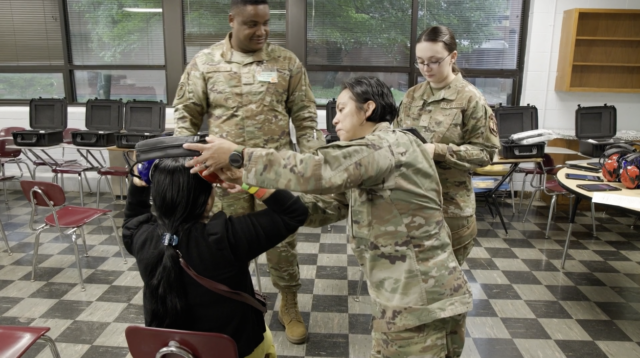
One of the most impressive aspects of this mission was how quickly Baker’s team got clinical operations up and running. Eleven WAHTS units were deployed in a school classroom, and a fully functional audiology clinic was operational within hours. No permanent infrastructure. No sound booths. Just a standardized workflow and the right technology.
The flow was straightforward and efficient. Patients checked in outside the audiology area, then proceeded to an otoscopy station, where Public Health Technicians performed a lighted ear examination to identify conditions, such as impacted cerumen, that could affect test results. From there, patients completed their hearing evaluation using the WAHTS. At checkout, results were reviewed and documented, and each patient received hearing health education, printed materials, hearing protection devices, and referrals for follow-up care as needed.
The outcome: 347 patients were seen in a school classroom, with an average visit time of 15 minutes, and no sound booth.
Each WAHTS unit arrived in its own Pelican-style protective case, which held up well throughout the multi-week deployment. Once on site, setup was quick, and every unit remained fully functional from start to finish.
What They Found
Over the course of the IRT, Baker’s team screened 302 adults and 45 pediatric patients, testing down to age 2.5. They met the annual hearing-readiness requirements for on-site military members. The estimated cost savings for the Henderson County community are approximately $15,000.
But the number that mattered most was not a volume statistic.
Many families had to be encouraged to bring their children in. Hearing tests were not something people automatically associated with a medical mission. Baker and her colleagues went out and made the case directly, family by family.
One of those conversations changed everything for a five-year-old boy.
He had failed his newborn hearing screening at birth. His family, without clear guidance on next steps, had never followed up. By age five, he was falling behind in school, and his speech was delayed. His family was searching for answers.
After Baker’s team identified the hearing loss and connected the family with a local audiologist for a comprehensive diagnostic evaluation, the pieces began to fall into place. The intervention, long overdue, may still arrive in time to make a real difference.
“That’s exactly why hearing services are just as essential as dental care, just as essential as ophthalmology. Our hearing health is critical. And getting the community and military leaders to understand that was the highlight of this whole trip.”
The Technology That Made It Possible
The clinic worked because the technology could keep up. Traditional audiometry would have made this impossible. Standard sound booths require fixed infrastructure, reliable power, and space that was simply unavailable in Henderson County. Midway through the mission, the team had to relocate their entire operation to a new location.
With WAHTS, that was a non-event.
“We wouldn’t have been able to provide audiology services at all if it wasn’t for WAHTS. The throughput was fast. It was easy to pick up and go. And people were genuinely amazed that you could just do a hearing test on the fly.”
That adaptability had ripple effects. Two on-site physicians asked to learn how the units worked, and Baker trained them without complications. The system was practical enough that expanding the team’s testing capacity mid-mission required no additional setup or technical support.
For patients, the experience itself was a revelation. Most people expect a hearing test to involve an enclosed booth, buttons, and a long wait. Seeing the process unfold at a table in an open classroom, without the usual trappings, changed what they thought was possible.
“It leveled the playing field. Hearing care, right alongside eyes and teeth. It just made sense to people in a way it hadn’t before.”
What Happens Next
On Distinguished Visitors Day, Pentagon leadership came to Henderson County to observe the IRT in action. When they arrived at the audiology clinic, what they saw prompted conversations Baker is still working to formalize: procurement discussions for WAHTS units across future IRT deployments.
Baker is now developing the after-action report, which will serve as the template for integrating hearing services into IRT deployments. As she describes it, it is a foundation on which everything else can build.
“What we built in six weeks, with loaned units and a team that had never done this before, that’s a template. And WAHTS is going to be part of every IRT going forward. No doubt.”
The need is documented, and the program is replicable. For the first time in the IRT’s history, the infrastructure exists to meet it.
The Technology Behind the Reach
While this mission was driven by people, purpose, and partnership, delivering care at this scale required the right tools in the field.
In settings where traditional audiology is not feasible, WAHTS offer the flexibility to reach patients wherever they are. Without the need for sound booths, fixed infrastructure, or reliable power, clinicians can administer accurate hearing tests in classrooms, community centers, and other open settings.
WAHTS’ portability translates directly into impact:
- Testing can occur anywhere, without setup constraints
- More patients can be reached in less time
- Reliable results can be obtained even in noisy, non-clinical environments
- Care is no longer constrained by geography or infrastructure
As Baker describes it, WAHTS did not just make the mission easier. It made the mission possible.
And in places where hearing care has never existed before, that kind of capability is not just valuable. It is essential.